When the upper tomato canopy stays bright while the middle and lower sections receive much less light, record where and when low-light areas appear. Then check the canopy and greenhouse structure. This guide applies to likely cases of uneven light distribution. For projects still identifying the problem, see how to recognize direct light, diffuse light, and uneven light distribution in a greenhouse.
This framework helps growers prepare for a specialist discussion. Photos and simple notes can document recurring patterns. A crop advisor, greenhouse agronomist, or specialist should assess changes to stem density, leaf removal, materials, or supplemental lighting using site data.
Step 1: Use Simple Records to Locate Low-Light Areas
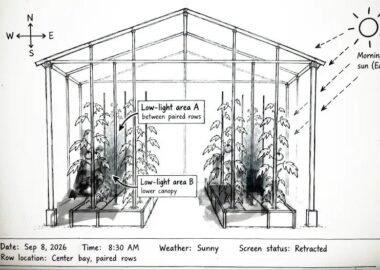
Initial records can begin with phone photos and a simple greenhouse sketch. The sketch only needs to show the crop rows and main structures. Choose one or two representative growing areas. Photograph the canopy from a fixed position and a similar angle in the morning, around midday, and in the afternoon. Add more records during any period when the problem is most noticeable.
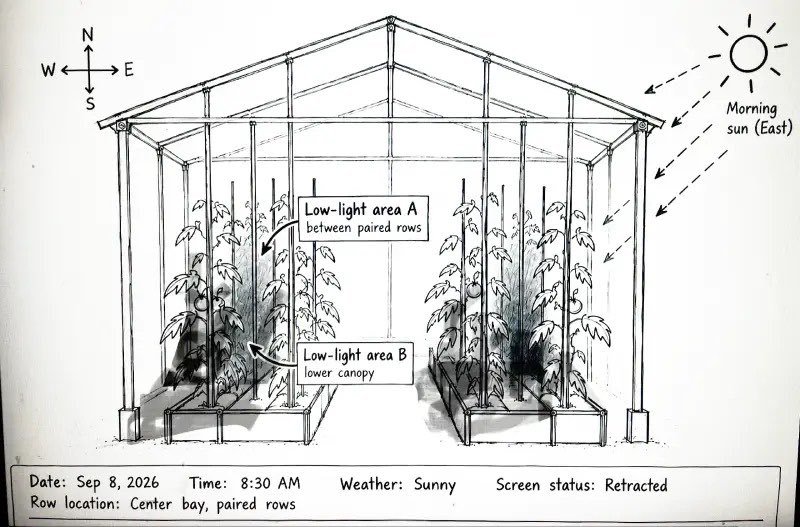
Mark the areas that receive less light on the sketch or photos. These may include the middle or lower canopy, the space inside double rows, greenhouse edges, or areas below a fixed structure. For each record, note:
- the date and time;
- whether the weather was sunny, cloudy, or overcast;
- the crop row and approximate canopy height;
- the covering material and whether the screens were deployed or retracted;
- whether supplemental lighting was operating;
- the crop stage and any recent leaf removal or crop lowering.
Phones adjust exposure automatically, so photos are most useful for recording the location and movement of shadows. Accurate comparisons between locations require a sensor designed for plant-light measurements. Where instruments are available, photosynthetic photon flux density (PPFD) describes the amount of photosynthetically active light reaching a measurement point each second. Daily light integral (DLI) describes the total received over a full day.
Greenhouse crop research often uses measurements from several canopy heights to describe vertical differences in light. One study of a mature tomato canopy used this approach. See the study A specialist should set the measurement locations and spacing for a commercial greenhouse. The assessment criteria should reflect the greenhouse structure, crop stage, and purpose of the assessment.
After this initial review, the grower should know where the low-light areas occur and when they usually appear. The records should also show whether these areas repeatedly correspond to a canopy level, crop row, or greenhouse structure. This information gives a specialist a clearer starting point for further assessment.
Step 2: Check the Canopy and Greenhouse Structure
The tomato canopy and greenhouse equipment both affect the distribution of incoming light. Check crop management, cleaning, and maintenance conditions first. Then assess materials or equipment based on the low-light areas that remain.
Check Canopy Density and Row Layout
As tall tomato crops develop a deep canopy, the upper leaves intercept a larger share of the incoming light. Low-light areas that occur mainly in dense foliage, inside double rows, or where adjacent canopies meet may be linked to self-shading. Stem density, leaf removal, and crop lowering all affect how deeply light enters the canopy. They also affect effective leaf area, fruit protection, and crop balance, so the growing team should decide any adjustment according to crop condition.
Row direction and layout also affect when and how evenly plants receive light. A tomato study from Wageningen University & Research found that north-south rows had more uniform light absorption than east-west rows. The same study found that plant acclimation kept the effect of row direction on overall crop photosynthesis small. See the study Row direction and layout therefore need to be assessed together with greenhouse structure and crop management.
Check Coverings and Fixed Equipment
Low-light areas that repeatedly align with trusses, gutters, pipes, lighting equipment, or retracted screens point to greenhouse structures that need attention. Dust on the covering and condensation on its inner surface can also reduce the usable light entering the greenhouse. University of Florida IFAS Extension identifies covering cleanliness and condensation as factors that affect greenhouse light transmission. See the guidance
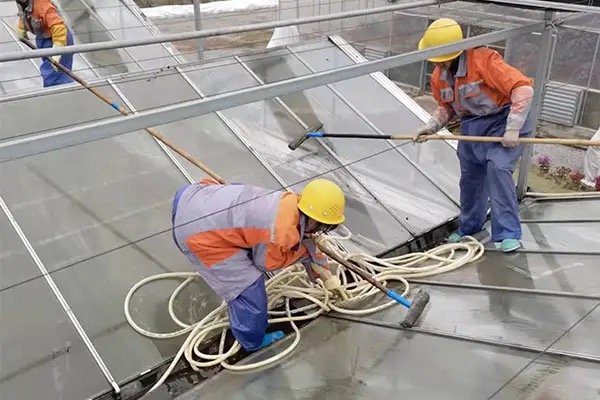
Observe the same route at different times to separate fixed obstructions from shadows that move with the sun. Complete the required cleaning and maintenance, and check where movable equipment is parked. If the affected area becomes smaller after these changes, keep the existing material configuration under observation.
Step 3: Match the Measure to the Location of the Problem
After checking the canopy and greenhouse structures, select a suitable measure for the remaining problem. The aim is to direct more light toward the area that needs it and improve light distribution through the greenhouse crop.
| What You Observe | First Area to Check | Measure to Consider | What to Verify Afterwards |
|---|---|---|---|
| The upper canopy is bright, while the middle and lower canopy receive less light for long periods | Stem density, leaf area, leaf removal, and crop lowering | A light-diffusing covering, movable light-diffuse screen, or reflective material below the canopy | Whether more light reaches the middle and lower canopy while overall light input remains acceptable |
| The inside of double rows or certain crop rows receives less light | Row spacing, row direction, single- or double-row layout | Adjust the layout; where this is impractical, assess a light-redistribution measure | Whether differences between crop rows become smaller |
| Low-light areas repeatedly align with trusses, pipes, or equipment | Cleaning, maintenance, equipment position, and the location of a retracted screen | Where the obstruction remains, assess a diffuse material | Whether the duration and area of the shadow change |
| Light reaches the floor or aisle while the lower canopy remains dark | Floor color and where the incoming light lands | White ground cover or another tested reflective surface | Whether reflected light reaches the target canopy level |
| Several areas receive little light during a low-light season | Covering transmission, screen position, outdoor solar radiation, and daily light total | Reduce avoidable light losses, then assess supplemental lighting separately | Whether total light input increases |
When Incoming Light Is Sufficient but Highly Directional: Assess Diffusion
Diffuse materials scatter directional incoming light across a wider range of directions. This can reduce the difference between bright sunflecks and shaded areas and help light enter deeper parts of the canopy. A tomato canopy study compared different levels of diffusion under similar total light transmission. Higher diffusion produced a more uniform horizontal and vertical PPFD distribution and increased calculated crop photosynthesis under the study conditions. See the study
The study supports the mechanism by which diffusion may improve canopy light distribution. Results in a commercial project also depend on canopy structure, sun position, season, and the optical properties of the material. Each screen, film, or glazing material should therefore be assessed using its own data and the conditions of the greenhouse.
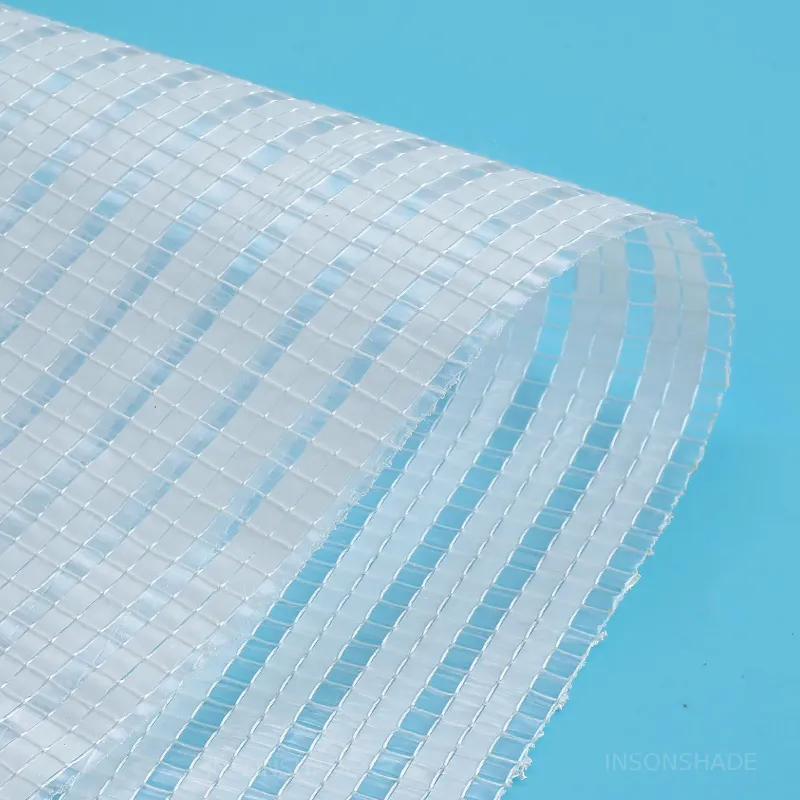
Material comparisons cover three parts. First, check how much light passes through the material. Next, review the directions in which that light is scattered. Then examine how the screen structure and operating strategy fit the greenhouse. PAR transmission or hemispherical light transmission can describe the total light passing through a material. Scattering performance must be interpreted according to the metric and test method used. Some technical sheets report diffuseness, while others use haze. Each metric describes a different aspect of scattering. Shading, transmission, and scattering data should be reviewed separately.
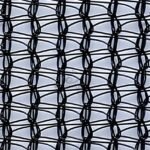
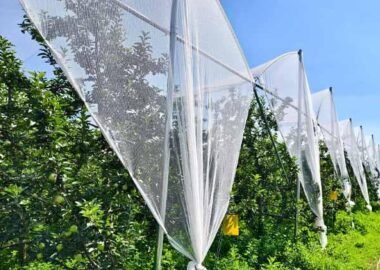
A movable light-diffuse screen may be considered when the problem is concentrated in a particular season or high-radiation period. The screen can be deployed or retracted as conditions change. INSONSHADE Diffusa belongs to this material category.
When Light Reaches the Floor or Aisle: Assess Reflective Surfaces
White ground covers and other reflective surfaces can redirect some of the light that reaches the floor, aisle, or greenhouse edge back toward the canopy. This reuses solar radiation that is already inside the greenhouse. Both UMass Extension and University of Florida greenhouse tomato guidance discuss white reflective ground surfaces as a way to increase light within the crop canopy. See the UMass guidance
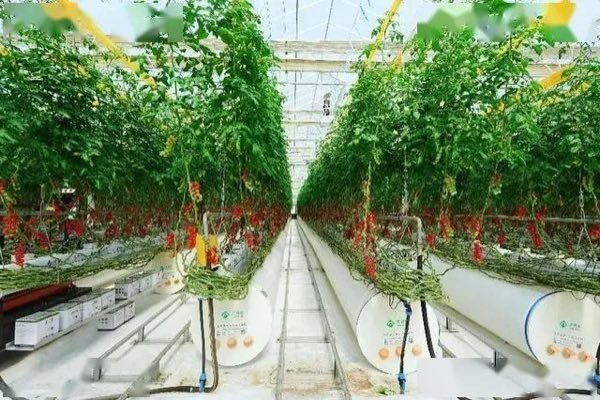
The result depends on where sunlight lands, the direction of the reflective surface, and its distance from the crop. A study in a Chinese solar greenhouse found that film height and position changed light distribution within the tomato canopy. See the study The structure of a Chinese solar greenhouse differs from common commercial glasshouse designs, so the arrangement applies to the trial conditions. Other greenhouse structures require a separate assessment of whether reflected light reaches the target area, along with access, cleaning, and crop-protection requirements.
When Total Light Is Low Across Several Areas: Assess Supplemental Lighting Separately
Redistributing sunlight changes where the available light reaches the crop. During a low-light season, several canopy levels and crop rows may all receive little light. In this situation, the greenhouse needs more usable light overall. First check the covering’s transmission, surface dust, and screen operation for avoidable losses. Supplemental lighting can then be assessed as a separate task.
Top lighting adds light mainly from above, while intra-canopy lighting changes its vertical distribution. Tomato research shows that combining top and intra-canopy lighting can change the light received by different leaf layers. Leaf acclimation, fixture heat, physical obstruction, and operating strategy also influence crop response. See the study Fixture selection, layout, control, and economic assessment should be handled separately by the growing and lighting teams.
Step 4: Have Key Changes Verified by a Specialist
The greenhouse team can complete routine cleaning and equipment position checks under its normal operating procedures. Specialists responsible for crop management or system design should assess changes to stem density, leaf removal, crop layout, screen materials, or supplemental lighting. They can first test a change in a manageable area or during a defined operating period.
Measurements should return to the original low-light area under similar weather, crop stage, canopy condition, and equipment settings. The assessment should cover changes at the target location, total light input, and differences between canopy levels. The growing team can also record canopy development, fruit growth, and operational conditions as supporting information.
Before expanding the measure, the project team should be able to answer three questions:
- Has the recurring low-light area improved?
- Is the improvement occurring at the target canopy level and crop row?
- Are the effects on total transmission, operation, and crop management acceptable?
Once the three answers are supported by clear field evidence, the project team can decide whether to expand the measure.
Final Thoughts
When initial records repeatedly point to the same area, share them with a crop advisor or greenhouse agronomist. The next assessment can then confirm the source of the problem and identify a suitable measure to test. Teams that want to develop in-house monitoring skills can learn these methods through agricultural extension services, universities, or professional greenhouse production courses.
If a professional assessment identifies a movable light-diffuse screen as a suitable option, see how this material category is used in greenhouse light diffusion management. The final material comparison should reflect the target operating period, greenhouse conditions, and confirmed optical data for each product.