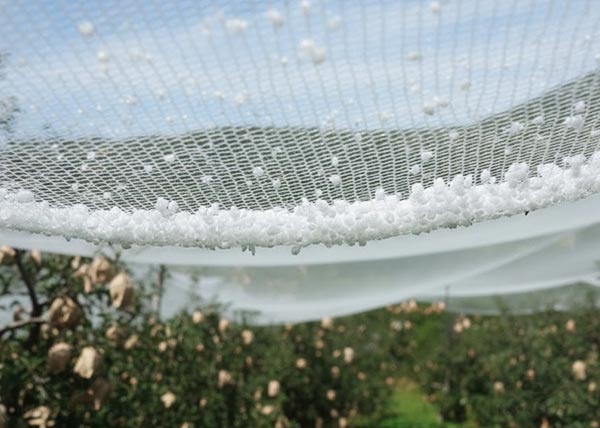
Anti-hail netting requires an upfront investment in both materials and installation. However, for orchards at high hail risk, it can provide long-term value by reducing fruit damage, protecting marketable yield, and lowering business risks associated with severe weather.
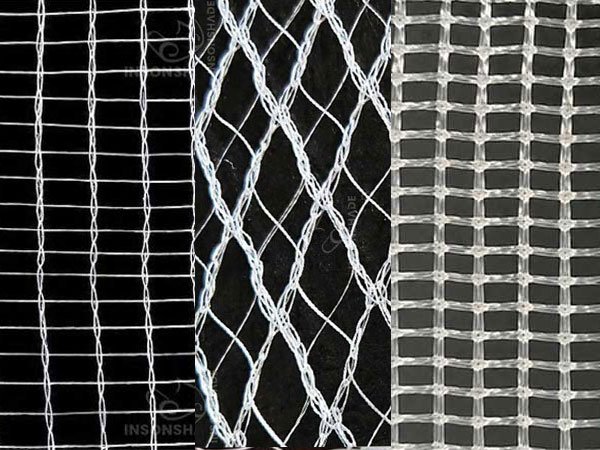
When choosing anti-hail netting, it is not enough to compare only mesh size, weight, or price. Different structures, such as Raschel-knitted, Leno-woven, and Plain-woven, can affect flexibility, dimensional stability, installation, local damage performance, and future maintenance. Even when two nets look similar, their structures may make them better suited to different orchard systems and operating conditions.
As a manufacturer of agricultural protection netting, INSONSHADE will explain the differences among these three common anti-hail net structures from both manufacturing and practical-use perspectives. This guide will help orchard owners, agricultural project buyers, and distributors choose a more suitable structure based on hail risk, installation method, maintenance cost, and purchasing budget.
Woven and Knitted: Understanding the Two Main Net Structures
From a manufacturing perspective, common orchard anti-hail nets fall into two main groups: woven and knitted nets.
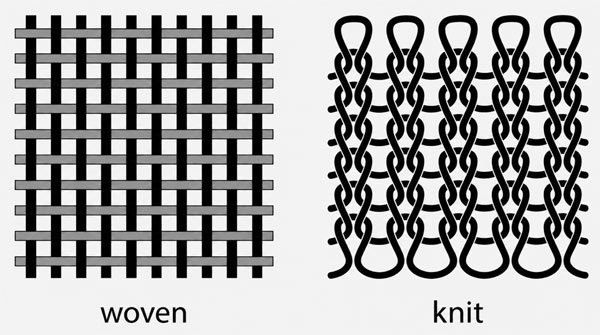
Plain woven and Leno woven are both woven fabrics, but they arrange the warp and weft yarns differently. Plain woven netting uses a basic over-and-under yarn pattern. Leno woven netting uses crossed or twisted warp yarns to hold the weft yarns in place, thereby improving mesh and surface stability.
Raschel knitted netting belongs to the warp-knitted category. It is made by forming, overlapping, and connecting yarn loops into a continuous net surface. This structure usually provides greater flexibility and a better ability to handle shape changes.
Quick Comparison of Three Anti-Hail Net Structures
Before looking at each structure in detail, the table below gives a quick overview of the main differences between Raschel knitted, Leno woven, and Plain woven anti-hail nets.
It is important to note that this table shows the general performance tendencies of each structure, not a fixed product grade. The actual strength, stability, and service life of an anti-hail net also depend on the HDPE material, yarn specifications, fabric weight, mesh size, UV stabilization, reinforcement design, edge treatment, and installation system.
| Comparison Factor | Raschel Knitted | Leno Woven | Plain Woven |
|---|---|---|---|
| Net Structure | A warp-knitted structure made by forming, overlapping, and connecting yarn loops into a continuous net surface | Crossed or twisted warp yarns hold the weft yarns in place, creating a more stable locked mesh | Warp and weft yarns form the net through a basic over-and-under weaving pattern |
| Net Surface | Usually more flexible and better able to handle some tension changes and irregular coverage areas | Mesh shape and yarn position are usually more stable | Simple and regular, but more sensitive to installation tension and edge treatment |
| Dimensional Stability | Medium to high, depending on the knitting pattern, density, and reinforcement design | Usually high because the twisted warp structure helps reduce weft yarn movement | Basic to medium, depending on yarn specifications, weaving density, and installation |
| Ability to Handle Shape Changes | Usually good and better suited to laying, rolling, and local tension changes | Designed to keep the mesh and net surface in shape, making it suitable for systems with stable tension | Requires more even tension control to avoid areas that are too loose or too tight |
| Performance After Local Damage | Depends on the knitting pattern; locked or multi-directional reinforced designs may help limit tear growth | The twisted structure helps reduce yarn movement, but damaged areas still need timely repair | Broken yarns should be repaired quickly to prevent further damage under continued tension |
| Installation and Rolling | Usually softer and easier to install, remove, and roll up for seasonal use | More stable and better suited to fixed systems or projects with less frequent removal | Can be used seasonally, but folding, rubbing, and edge stress require more attention |
| Cost Range | Available from basic designs to multi-directional reinforced products, so prices can vary widely | Cost depends on monofilament size, fabric weight, locking density, and roll width | Basic specifications usually make the initial purchase cost easier to control |
| Maintenance | Usually more suitable for complex frames and frequent handling, but friction points and connections still need inspection | When installed and tensioned correctly, stable mesh can help reduce maintenance needs | Requires more attention to installation quality, edge reinforcement, and local repairs |
| Typical Projects to Evaluate First | Complex orchard frames, seasonal use, and projects that require flexible installation | Long-term fixed protection systems that need stable mesh and controlled maintenance | Low-hail-risk areas, budget-sensitive projects, or orchards with basic protection needs |
| Key Buying Points | Knitting pattern, warp-knit density, reinforcement direction, fabric weight, and edge design | Warp locking method, mesh stability, monofilament size, reinforced edges, and seams | Yarn strength, weaving density, UV treatment, edge reinforcement, and size tolerance |
1. Raschel Knitted Anti-Hail Nets
Raschel knitted anti-hail netting is a type of warp-knitted net. During production, the warp yarns form loops, overlap, and connect to create a continuous net surface. Compared with basic woven structures, Raschel netting is usually more flexible and can better handle unfolding, rolling, and local tension changes during installation.
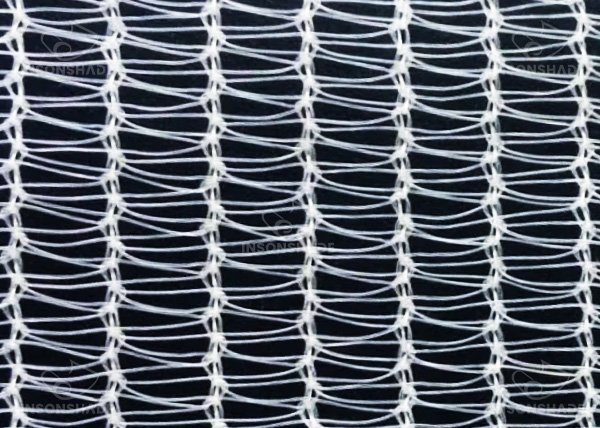
In appearance, Raschel anti-hail nets may have chain-shaped, curved, diamond-shaped, or crossover patterns. However, these visible patterns only show the knitting structure and yarn path. They do not directly prove the product’s strength, grade, or service life.
Standard and Reinforced Raschel Knitted Anti-Hail Nets
Not all Raschel knitted anti-hail nets are the same. Based on the knitting pattern, yarn direction, and reinforcement design, they can generally be divided into standard structures and multi-directional reinforced structures.
Standard Raschel netting usually focuses more on low weight, flexibility, and easy handling. It is suitable for general orchard hail protection, seasonal covering, and projects that require regular installation and rolling. When mesh size, fabric weight, and yarn specifications are similar, it can usually adapt better than more rigid woven netting to irregular frames and local tension changes.
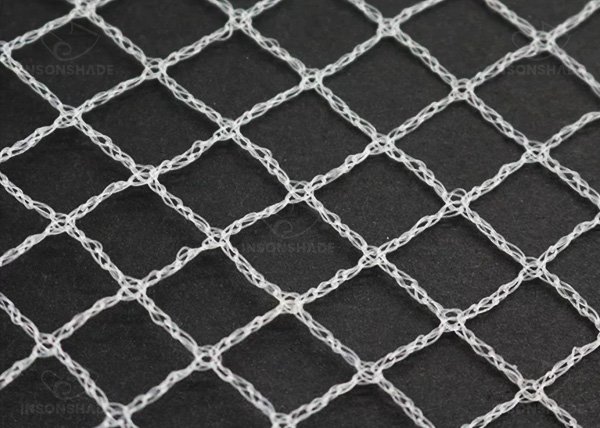
Reinforced Raschel anti-hail nets add crossover yarns, multi-directional connections, or reinforced sections to the basic knitted structure. Common market names may include:
- Quad crossover
- Four-way knitted
- Diamond lock-stitch
- Crossover net
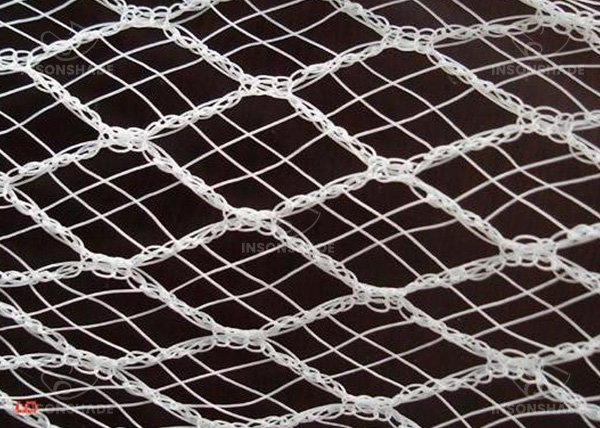
These names are often used to describe multi-directional load support or reinforced knitting patterns. However, they are not fully standardized international grades. Two suppliers may use similar product names while offering different yarn counts, knitting patterns, fabric weights, and strength levels.
Do Not Judge Product Grade by Appearance Alone
Crescent-shaped, triangular, diamond-shaped, or crossover mesh patterns can help buyers identify the general knitting structure. However, mesh appearance alone does not reflect the product’s true quality.
When comparing Raschel knitted anti-hail nets, buyers should check several factors together:
- Knitting pattern and yarn connection method
- Weight per square meter
- Yarn specifications and raw material quality
- Strength in both warp and cross directions
- Multi-directional reinforcement design
- Edge, seam, and connection treatment
- UV stabilization
- Compatibility with the orchard installation system
For example, two anti-hail nets may both look like diamond or crossover structures. However, if they use different yarn sizes, fabric weights, or reinforcement patterns, their tensile strength and long-term stability may vary significantly.
Which Projects Are Better Suited to Raschel Netting?
The main value of Raschel-knitted anti-hail netting lies not only in its lower weight. It also offers good flexibility across different orchard frames and installation methods.
Raschel structures are often worth evaluating for:
- Orchards with uneven land, different tree shapes, or irregular coverage areas
- Protection systems that require seasonal installation, removal, or rolling
- Projects with frequent local tension changes during installation
- Distributors or importers that need one product type for several orchard uses
- Orchards that also need some bird protection or shading in addition to hail protection
However, the term “Raschel knitted” does not mean that every product is stronger or more durable than Leno woven netting. Standard Raschel, reinforced Raschel, and products with different fabric weights can have very different performance levels.
2. Leno Woven Anti-Hail Nets
Leno woven anti-hail netting belongs to the woven category, but its yarn structure differs from that of basic Plain woven netting. In a Leno structure, two or more warp yarns cross or twist around the weft yarns and hold them in place. This creates a locked mesh that helps reduce yarn movement across the net surface.
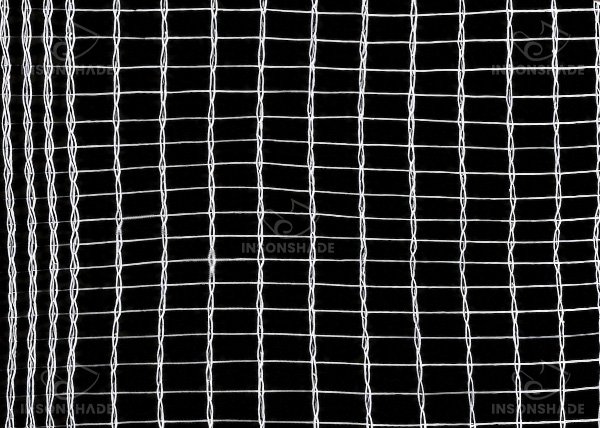
Leno-woven anti-hail nets usually have clear, twisted warp yarns and regular mesh openings. Compared with basic Plain woven netting, this locked structure helps the mesh keep its shape and improves dimensional stability. For this reason, Leno woven netting is often used in orchard protection systems that require long-term tension and fixed installation.
Why Does Leno Woven Netting Provide Better Mesh Stability?
After installation, an anti-hail net is affected by its own weight, wind, hail impact, temperature changes, and installation tension. If the warp and weft yarns move easily, some mesh openings may slowly lose their shape, and the tension across the net may become uneven.
The crossed warp yarns in a Leno structure help hold the weft yarns in place and reduce visible mesh movement. In fixed overhead protection systems, a more stable mesh and net surface can help maintain proper coverage and reduce the need for frequent re-tensioning.
However, better mesh stability does not mean the net cannot be damaged. Friction against sharp parts, continued overload, or strong hail impact may still cause broken yarns or tears. The main advantage of the Leno structure is that it helps reduce yarn movement and maintain the original mesh shape. It does not fully prevent damage.
Which Orchard Projects Are Better Suited to Leno Woven Hail Nets?
Leno woven anti-hail netting is usually more suitable for projects with stable installation systems, longer service periods, and a strong need for controlled maintenance, such as:
- Fixed or semi-fixed overhead orchard protection systems
- Projects that need the mesh and net surface to keep a regular shape over time
- High-value apple, pear, cherry, or grape growing areas
- Commercial orchards with higher hail risk and a focus on long-term crop protection
- Projects with high labor costs that want to reduce frequent re-tensioning
- Agricultural projects with strict requirements for roll width, mesh size, and batch consistency
Limits and Key Considerations
Leno woven netting offers good dimensional stability, but it is usually less flexible than softer Raschel knitted netting when used on complex land or in systems that require frequent rolling. If the net needs to be installed and removed several times each season, or if the frame has many irregular corners, more accurate size planning and tension control may be needed.
As with Raschel-knitted netting, the actual performance of a Leno-woven product still depends on its full specifications. A low-weight product made with thin monofilament or weak UV stabilization will not automatically provide a long service life simply because it uses a Leno structure. Good raw materials, suitable yarn specifications, and proper edge design are still needed for the locked woven structure to perform well.
3. Plain Woven Anti-Hail Nets
Plain woven anti-hail netting uses a basic woven structure. The warp and weft yarns cross in a regular over-and-under pattern without the twisted locking structure found in Leno woven netting. Because the production method is more direct, the specifications and initial purchase cost are usually easier to control.
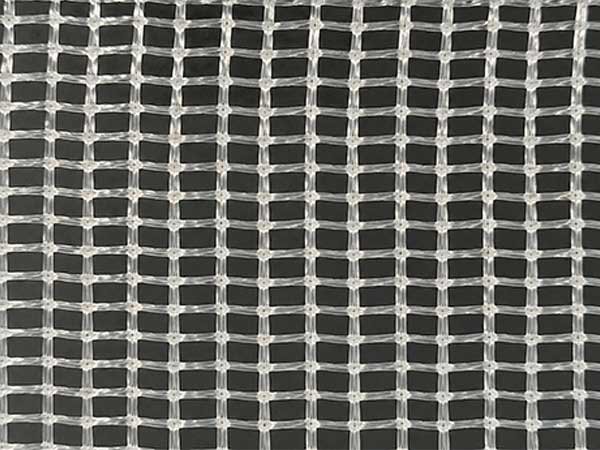
This type of anti-hail net is more suitable for orchards with lower hail risk, regular support frames, or limited budgets. For large areas that primarily need basic hail protection and can be inspected and maintained regularly, plain-woven netting can be a practical and cost-effective choice.
Limits of Plain Woven Hail Nets
Plain woven netting usually does not hold the warp and weft yarns as firmly as Leno woven netting. During installation, it is important to keep the tension even, reinforce the edges, and reduce friction around connection points.
If broken yarns or mesh deformation appear, they should be repaired early. Continued wind and tension may cause the damaged area to grow over time.
Which Anti-Hail Net Structure Is Right for Your Orchard or Project?
After understanding the main differences between the three structures, the next step is to match the net to your own project. Orchard layout, crop value, hail risk, installation system, and purchasing goals can all affect the final choice.
| Project Condition | Structure to Evaluate First | Main Reason |
|---|---|---|
| Seasonal installation, removal, or rolling is required | Raschel Knitted | The net surface is usually more flexible and easier to handle and roll |
| The frame is complex, the land is uneven, or tension changes often | Raschel Knitted | It can usually adapt better to irregular coverage areas and local shape changes |
| A fixed, long-term overhead protection system is needed | Leno Woven | The mesh and net surface usually provide better dimensional stability |
| The project protects high-value crops and needs controlled long-term maintenance | Leno Woven | The locked structure helps reduce yarn movement and visible mesh deformation |
| Hail risk is low and the initial budget is limited | Plain Woven | The basic structure usually makes the purchase cost easier to control |
| The frame is regular and the orchard can be inspected often | Plain Woven | Proper installation and timely maintenance can support basic protection needs |
| One net type must serve several orchard uses or distribution markets | Raschel Knitted | It usually offers a wider range of specifications and applications |
This table is only a starting point and should not replace a detailed product comparison. In addition to the net structure, buyers should also compare fabric weight, mesh size, yarn specifications, UV stabilization, edge design, and other product details.
Buying Tips for Anti-Hail Netting
After reviewing the three common anti-hail net structures, you may already have a general idea of which option fits your project. However, before requesting a quote, ordering samples, or placing a bulk order, you should still confirm both your project needs and the supplier’s capabilities.
Anti-hail netting is not a one-time disposable product. Its structure and quality can affect installation efficiency, future maintenance costs, and the level of orchard protection over several seasons.
1. Confirm Your Project Needs Before Choosing a Net Structure
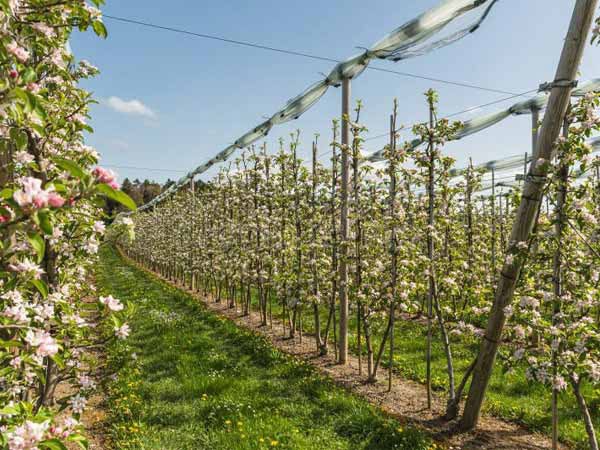
Before choosing Raschel knitted, Leno woven, or Plain woven netting, answer these five questions:
- Is your orchard in a low-, medium-, or high-hail-risk area?
- Will the net be used for seasonal coverage or as a long-term fixed overhead system?
- Are you more concerned about the initial purchase cost, future maintenance cost, or protecting high-value crops?
- Does the orchard need stable light and airflow to support fruit color and quality?
- How much labor can you provide for repairs, re-tensioning, seasonal installation, and rolling?
These questions can help you set the right purchasing direction instead of choosing only by price or sample appearance.
2. Check the Product and Supplier Details
Once you have selected a general structure, compare the actual product specifications and supplier capabilities. No matter which structure you choose, confirm the following details:
- Whether the net is made with stable HDPE material
- Whether it has reliable UV stabilization
- Whether the fabric weight, mesh size, and roll width meet the project requirements
- Whether color, fabric weight, and roll width stay consistent across bulk orders
- Whether the edges, seams, and reinforced areas match your installation method
- Whether the supplier can customize the net for your orchard, installation system, and target market
- Whether the supplier has stable bulk production and export experience
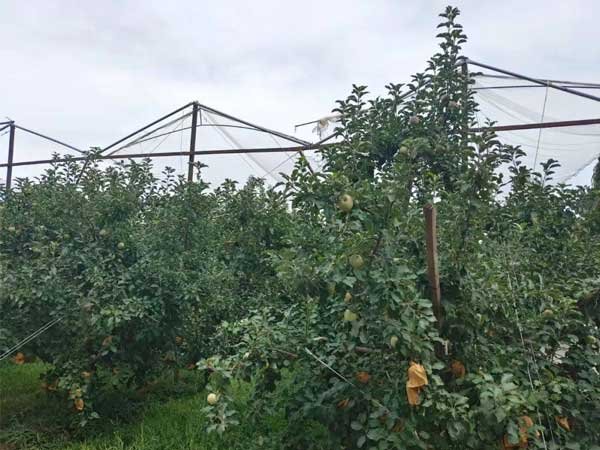
Whether you are a commercial orchard owner, an agricultural project buyer, a distributor, or an importer, choosing the net structure is only the first step. A reliable anti-hail netting solution must also match the project, provide consistent quality, and come from a stable, long-term supply source.
Conclusion
For an orchard with lower hail risk, a more affordable anti-hail net may provide enough protection. For high-value fruit projects, a structure with greater stability or flexibility may offer greater value over the long term.
The goal is not simply to find the strongest or cheapest net. A better decision considers hail risk, crop value, installation method, maintenance cost, and the expected return over the product’s service life.
As a manufacturer of agricultural protection netting, INSONSHADE supplies Raschel-knitted, Leno-woven, and Plain-woven anti-hail netting for various orchard systems, target markets, installation methods, and purchasing budgets.
If you are sourcing anti-hail netting for an orchard project, wholesale channel, or agricultural protection product line, contact INSONSHADE for product recommendations, custom specifications, and sample support.